

Finding Love's Color
Love, translation, and being alone for Thanksgiving weekend.

So I’ve been losing my mind all week. This Thanksgiving break, I stayed home alone to get a massive amount of grading and reading done, and all my roommates are gone and with their families and my parents are in southern Utah. I don’t know if the idiom “losing my mind” really captures the blur I’ve been feeling, the haze that’s been clouding my daily operations. If I’m losing anything, I think I’m losing my sense of self. You’d think your sense of self would be derived from some interior energy, but at least for me, I think a lot of myself is generated and maintained through conversation. In small chats with my students before class starts, in the endless, frolicking group consultations in my living room with friends, in the hours-long phone calls to my sisters where we bicker and cry and love—in these exchanges I carve some semblance of self.
This week, however, I cannot force anyone to stay in my house. So, I decided, this sleepy Friday after Thanksgiving, to slough off greater responsibility and indulge in my most failsafe medicine: a bike ride to Utah Lake. This might have been the last warm day of the year, though my friends probably tire of me saying that. Bundled up in my warmest coat (I found my knitted gloves I lost months ago!), I make my way against the fact of the wind. I can thank the improbably warm sun for making this pilgrimage bearable. And so I attempt this rehearsed journey, this ritual I have made a million times. Once I make it to the lake, out on the slim bouldered jetty that juts out into the lake at the state park marina, I sit down at one of the battered aluminum picnic tables and decide to meditate.
Or rather, photosynthesize. I am not trying to let my passions pass me by. I am trying to grab the sun’s warmth and strangle it into words. I am trying to metabolize its heat into revelation, beams radiating through my skin and resonating with the mortal coils of my soul. This is the poet’s curse, never leaving life alone. I don’t sit for very long before I see something I’ve been waiting for, looking for, asking for, for four years. I have found, on this improbably improbable day, my favorite color.
I doubt many 24-year-olds take their favorite color as seriously as I do. In part, I’m sure, it’s a quirk manufactured out of the raw pleasure of being so different from my surroundings in Provo. I find this pleasure insufferable. I don’t morally value being aesthetically alternative for the sake of itself. But I suppose I have bigger fish to fry, so I let myself revel quietly in the surprised looks I get at BYU: someone who looks like that goes to schools here? But with my favorite color, I do think it’s more than that. I have been gathering things close to this color for years, in polo shirts, ribbons and trims, stuffed animals, bedsheets, fruits, scraps of wrapping paper, post-it notes, and book covers, and anything else I can get my grubby mitts on. A couple weeks ago I finally was able to alchemize the color in nail polish. I want to keep them this color forever.
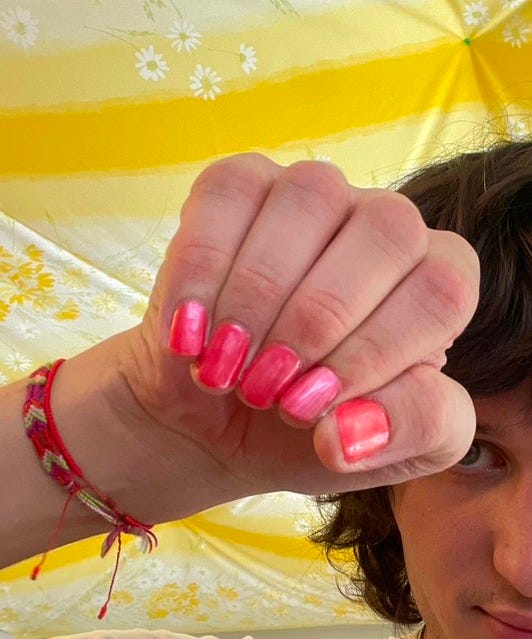
The color itself is some sort of off-red, though it’s difficult to say whether it’s of the pinkish or orangish persuasion. At least on some color wheels, pink lies on one side of red and orange on the other. The strange thing about this color is that it somehow captures both the cool delicacy of pink and the robust sunlit warmth of orange. It’s not quite vermillion, scarlet, salmon, or coral, but something else entirely. I’ve been able to approximate it in gel nail polish by layering a blue-green iridescent topcoat over a vibrant scarlet base. This is the color of unripe pomegranates, of roseate spoonbills, of ruddy cheeks. At least approximately. But never exactly.
There, out on the jetty, photosynthesizing among the roiling silty waves of Utah Lake, I saw my favorite color, the real thing itself, for the first time. It just so happens to be color of illuminated flesh, the sun pressing itself through the thin vellum of my eyelids. Skin, minute capillaries, membrane. The color of my very flesh, brilliant, alive, ever-present, eternal.
How strange it is, that the color was always there, in front my eyes, literally. The color is not actually the color of sunlight nor the color of my skin, but the conversation between the two, the translation, the bodily mediation. The translation, precisely.
Translation, I’ve been learning recently, is incredibly tricky business. One might assume that the real work at hand is to maintain the voice of the source text author as much as possible. To translate with utmost fidelity to the “original.” And yet here comes the rub: navigating translating word for word versus sense for sense is often, if not always, impossible. If the exact syntax and grammar of the original are translated in what is often referred to as a foreignized interpretation, then one runs the risk of not delivering the larger concepts and ideas to the target audience. The same rule holds in reverse. Translation, cynically put, is a fool’s errand. Well, that is, if the goal is to carry something across the abyss that divides each language from another with perfect fidelity.
Aarón Lacayo, among other scholars, firmly disrupts this assumption in arguing that the work of translation might be best understood through the form of interacting bodies, both queering and materializing work that is often understood as purely ephemeral. He reasons that “One might not know what texts are, but translation approaches texts as bodies. This encounter is marked, then, by an unbridgeable interval, opacities, and an ensuing remainder” (223). In other words, translators should accept that they can never reproduce a text with absolute fidelity, and that within this acceptance lies the real ethics of the practice: the radical centering of difference.
This is a fact we do not like. Not only in translation, but always and everywhere. We like to know the world as it is, we like our news reports to funnel accurate, factual information to the public, we like the idea that when we love someone, we can truly know them as they are. This is an enticing idea, of course. There is a serious pleasure associated with seeing the world as systematic, divisible, understandable. Religion and science are often coconspirators in promulgating this sort of hermeneutics. And this, of course, is the ancient engine which propels conspiracy thinking into the core of our democracy.
But I would like to perhaps expand what Lacayo is saying here beyond just translation. Indeed, many contemporary translation scholars insist that all we really do with texts is translate them, that every edition, every adaptation, even every individual, contextualized experience is best understood through the framework of translation. But I mean even bigger. I think I intend to speak of the real stuff of life, the serious business of existence. Of love.
Recently, with all this translation theory swimming around in my head, I’ve attempted a few translations of Rilke using my shoddy German skills I have developed over the past couple of years. I know I’m not doing a terrific job, but there is something remarkable about the practice of translation itself, getting up close to the language, to the ideas, and handling each word and sound with such immense care. In my translation of Rilke’s sonnet, “Lovesong”, I think I have learned most seriously what translation might have to do with love:
How should I handle my soul, so
that it doesn’t touch yours? How should I
lift it up over you to other things?
I would gladly harbor it by
the other Things-lost-in-the-dark,
in that still strange spot that
doesn’t echo your vibrating depths.
And yet all of it, all that touches you and me,
draws us together like a bowstroke,
resounding a singular voice from two strings.
What instrument stretches us?
And who holds us in their hand?
Ah, sweet song.
We are separate strings that don’t make contact and yet we somehow resonate at harmonic frequencies. I do think there’s a great arrogance in thinking we can actually know someone else. I’ve heard this is often what causes marriages to crumble, when someone assumes they can read their spouses mind or that their spouse can read theirs. Rilke seems to suggest that keeping our souls at arm’s length away from our lovers’ might actually produce richer resonance than if we crowd each other out, which young love so often induces us to do.
He explains this notion more directly in one of his letter to Franz Kappus, as translated by Charlie Louth: “[…]for the individual [love] is a grand opportunity to mature, to become something in himself, to become a world, to become a world in himself for another’s sake; it is a great immoderate demand made upon the self, something that singles him out and summons him to vast designs” (49-50).
It seems that in the metaphor of translation, love is not the knowing nor the artificial fidelity from one body to another, but rather the act of translation itself, the act of knowing as such. When the lover shines his light towards your eyes, the color of real love is not his love nor your reception of it, but the way it casts itself through your flesh, some red-orange-pink without a name. As if we could ever capture the color of love with a mere word.
There is some danger, I suppose, in giving up on the idea of fidelity. Of course, I don’t intend to descend into moral relativism or magical thinking. Recentering the mediating act itself runs the risk of dislodging any shared notion of truth we might subscribe to. But I think it might also reveal to us the uncomfortable though deeply pleasurable fact of our bodies. This vessel we are always trying to run from. It might return us to the reality that we are indeed alien worlds to each other, and crucially, that that is a thing to delight in.
Here, I think of the other Rilke poem I attempted to translate, the prelude to the first book of The Book of Pictures:
Whoever you are: when evening comes,
step out of your room
(where you know everything).
Whoever you are: your house lies before
the infinite expanse.
With your eyes
(which free themselves wearily
from the well-worn doorstep)
heave up a black tree
and fix it against the sky,
slender and solitary.
There. you have formed the world.
And it is grand, like a word still
ripening in utter silence.
As your spirit surrender to your senses,
Tenderly release your searching eyes.
We are always meaning-making, viciously and endlessly. It is terrifying to step into the abyss of the infinite expanse, where we really do not know everything, or anything. When I am overwhelmed by this prospect, when it all feels too vast and cosmic, I turn to the outside world, like the poem suggests. When I lose myself (my sense of self, that is), I return myself to the world. I am reminded in this act that I can indeed release my searching eyes, and simply let it all—the world, a word, the tree, anything—ripen in utter silence. This is enough. My body here, your body there. The conversation of our bodies together.
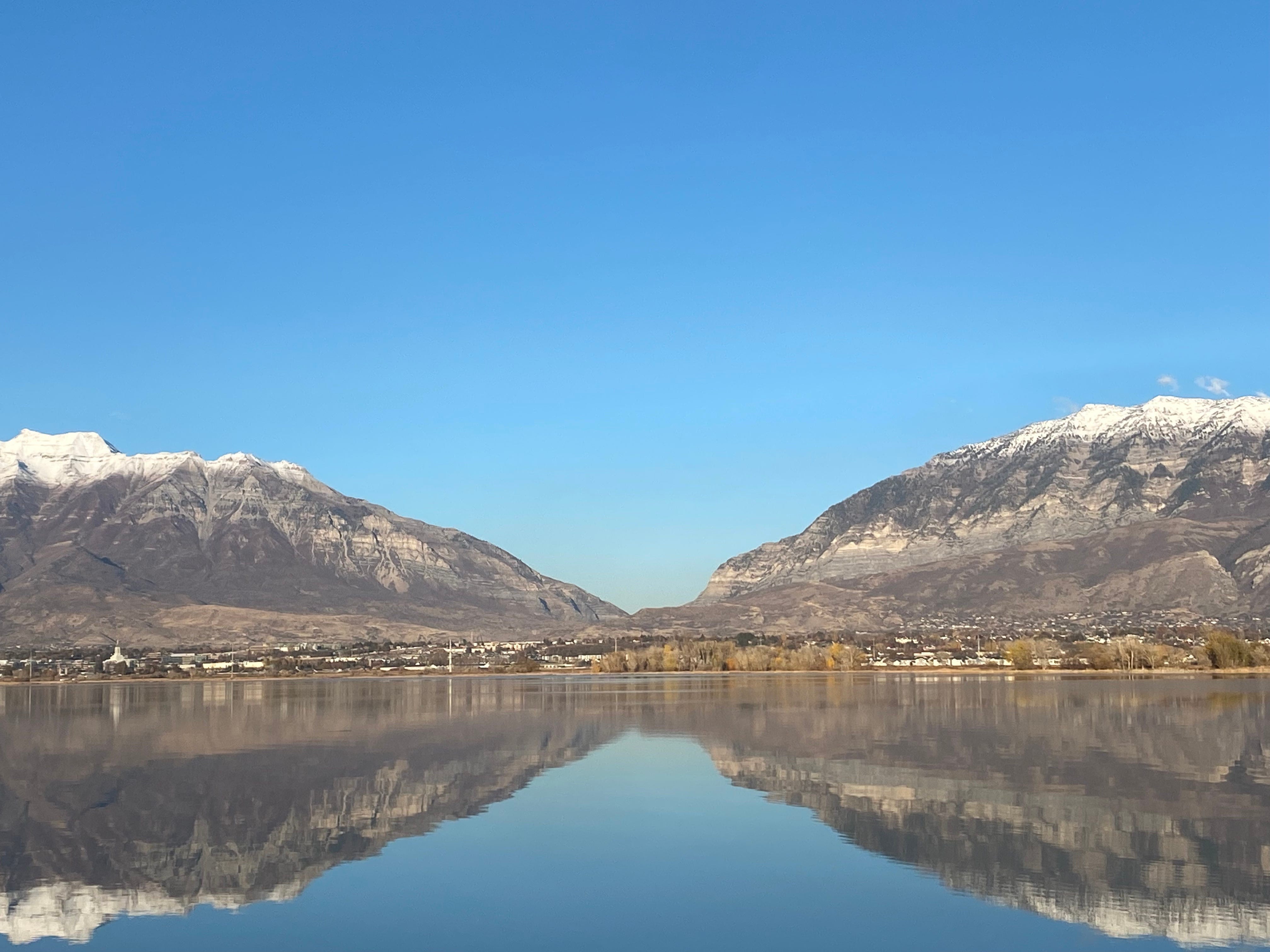
I make the pilgrimage out to the lake to see the water, but the main attraction as far as I’m concerned is examining the shape of the mouth of Provo Canyon. I could sit for hours, inspecting every layer of the crumbling limestone, every speck and spot of pine or scrub oak, every swatch of cheatgrass.
So. You. Meet me there, at the creek bed that divides the canyon in two, at the borderland that divides the mountains, those glorious worlds that we are creating unto ourselves for the sake of each other. Tell me what you find. Don’t tell me what it means. Explain the shapes you find in the exposed limestone. Count every leaf, every insect. I’ll do the same. Then, as we report to each other, our conversation will rise and clang against the ancient walls of the canyon, and we will begin to sing, never touching, but vibrating in harmonic tones. This is when I will tell you the real color of love, this massive and important secret I’ve been hiding in my hands, just to give to you. This is when the knowing, that urgent straining, will finally crumble away and we will stand against each other, knowing nothing at all, and, for the first time, feeling absolutely all of it.
References:
Lacayo, Aarón. “A Queer and Embodied Translation: Ethics of Difference and Erotics of Distance.” Comparative Literature Studies, vol. 51, no. 2 (2014), pp. 215-230. https://www.jstor.org/stable/10.5325/complitstudies.51.2.0215
For the Rilke poems I translated, I used M.D. Herter Norton’s Translations from the Poetry of Rainer Maria Rilke (New York: Norton, 1962).
The edition of Rilke’s Letters to a Young Poet I used was Charlie Louth’s translation published by Penguin Classics in 2013. Mabel bought me this at a little radical bookstore in Edinburgh because she knew I had given away my first copy to a friend.
Luka 🩷🩷 translation is a fools errand- and I can never actually capture a picture of the pink-orange sunset (my favorite color) on my phone. It must be seen and felt
Oh Utah Lake my lovely friend